
Blog
Why Most First-Time Managers Fail in Year One (And What Actually Prevents It)
By The Nextwave Leaders
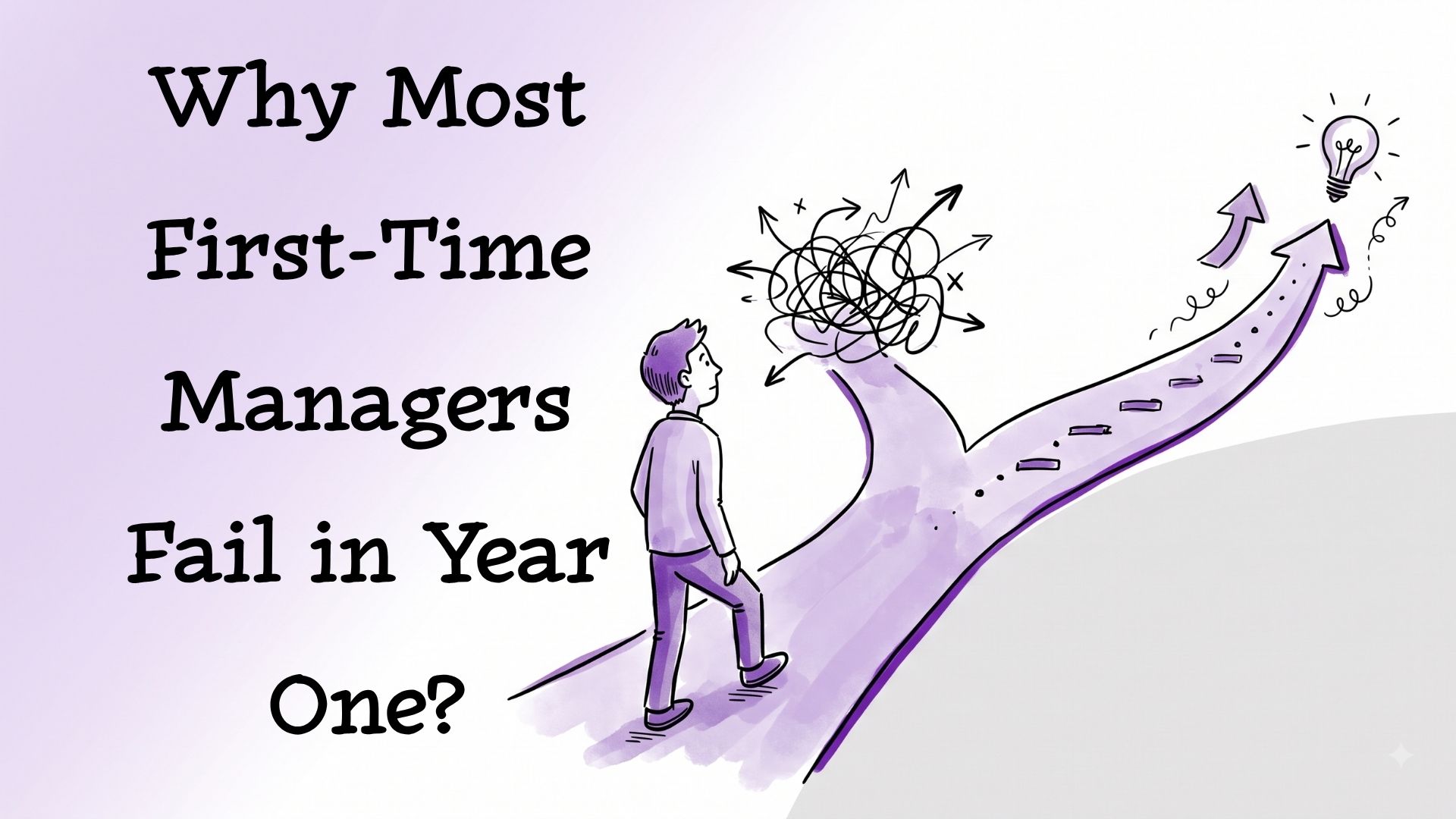
Quick answer: Most first-time managers don't fail in year one because they lack talent, ambition, or good intentions. They fail because they're promoted for one skillset (technical excellence, individual output) and then handed a completely different job (leading humans) with zero training for it. The gap isn't character. It's preparation. At The Nextwave Leaders, we call this being under-equipped, not uncaring, and it's the single most important idea in first-time manager development.
The Promotion That Looks Like a Reward
Picture the employee every leader wants on their team. He's a subject matter expert. He closes the most tickets in every sprint. His velocity is the highest on the team. Stakeholders trust his estimates. Leadership notices his name in every retro.
Professionally, there are only a few ways to recognize someone like this: an award, a bonus, or a promotion. And if he's genuinely exceptional, an award and a bonus stop being enough fairly quickly. Eventually, the natural next step feels obvious: promote him to lead the people around him.
It looks like a reward. It's actually a job change.
The Skill That Made Him Great Is Invisible, Even to Him
Here's the part almost every organization overlooks: being excellent at the work and knowing how to help others get the work done are two entirely different skills.
Experts don't consciously think through the steps that get them to a result anymore. Years of repetition have turned expertise into instinct. That's what mastery looks like: the process becomes invisible, automatic, unteachable by default.
Now put that same person in charge of getting other people to that same level of output. Suddenly he needs communication, guidance, patience with the slowest question in the room, the ability to keep morale up during a bad sprint, and the judgment to lead a team through change he never had to personally navigate before. None of that was part of the job he was actually promoted for excelling at.
And there's pressure attached to all of it. He has to prove the promotion was deserved. With no training and no framework, what's left to fall back on is whatever he experienced under his own managers, including the parts he privately disliked. There's no reliable way to know what "good" looks like, so the safe move is to either half-copy the previous generation's style, or overcorrect with big changes all at once to prove authority. Both routes tend to fail, because the world these new managers are leading in (hybrid teams, Gen Z expectations, AI-driven change) is asking for a completely different set of skills than the ones the previous generation needed.
This is the exact moment first-time manager training either exists, or doesn't.
Why Most Leadership Training Misses the Point
Most leadership training is really productivity training in disguise. It answers one question: how do I get more work out of my people? That's not nothing, but it's the wrong starting point, and it's why so much manager training doesn't stick.
The real foundation of good leadership isn't extracting more output. It's building a team that trusts and respects the manager enough to show up for them on a bad day. Delegation is a small piece of that picture. Productivity is a byproduct of it, not the goal.
A manager's actual job is to build a team that:
- Raises issues and blockers before they turn into rework
- Is willing to extend effort (stay late, work a weekend) when there's a genuine urgency, because they trust the ask is fair
- Can operate without the manager constantly checking in, because the team is equipped, not just supervised
A manager who's constantly putting out fires isn't proof of a demanding job. It's usually a sign the team was never actually equipped to handle things without them.
What Actually Prevents First-Year Failure
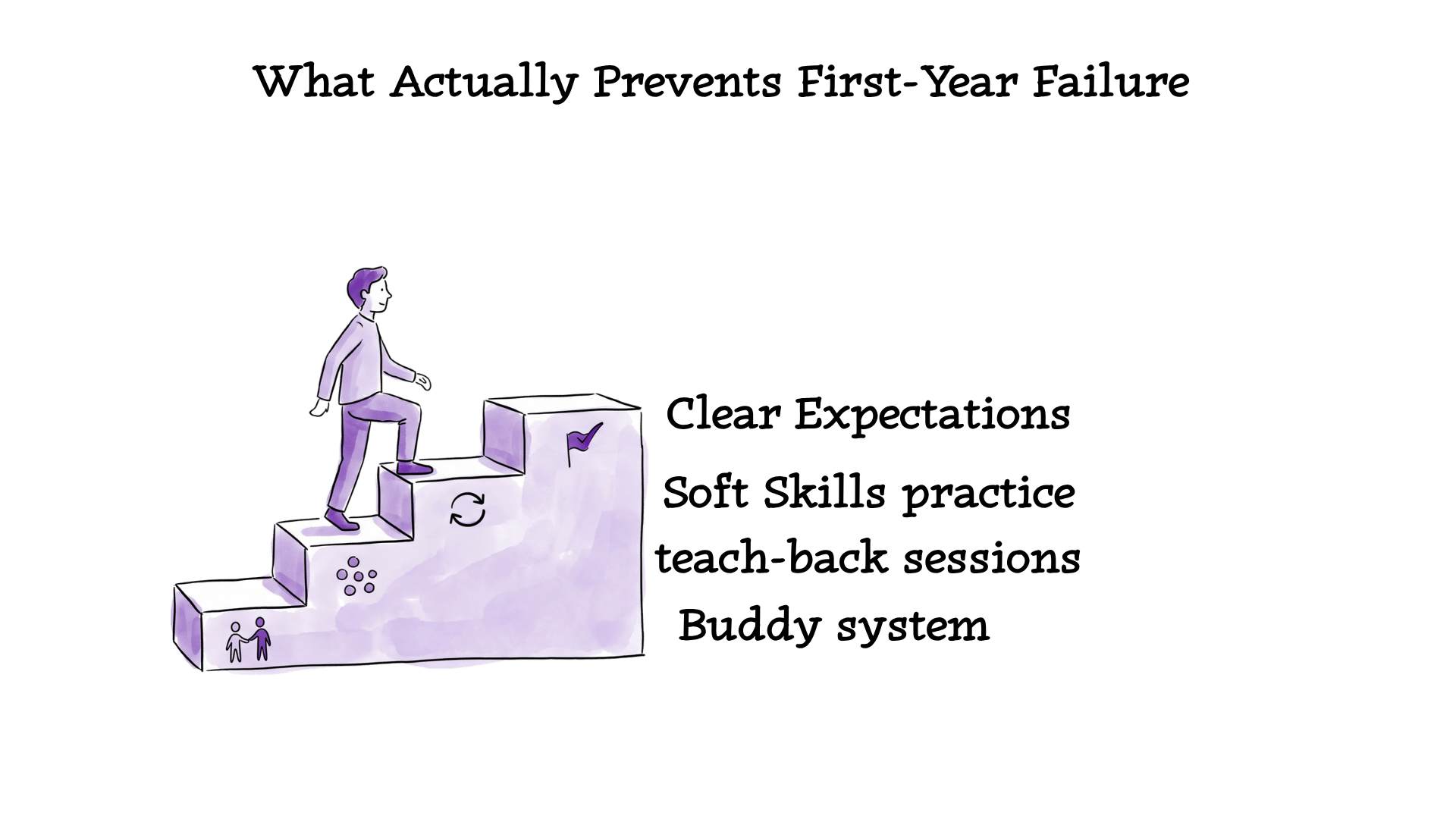
If the failure comes from being under-equipped, then the fix isn't a personality overhaul or a two-day workshop. It's a deliberate, staged buildup of the skills the role actually requires, started before the responsibility lands, not after.
- 1
Start with a buddy system, not a team. Before handing someone the entire team, assign them one junior colleague to guide and mentor. This is where communication, guidance, and patience get their first real rehearsal, at a scale low enough that mistakes are cheap.
- 2
Increase scope gradually. Grow the number of people they're responsible for step by step. Give them chances to run teach-back sessions, so they practice explaining, not just doing.
- 3
Treat soft skills as a practice, not an event. Communication, feedback, and conflict management don't build after one presentation or one workshop. They build through repetition, the same way the technical expertise that got this person promoted was built in the first place.
- 4
Set clear expectations before the title changes. A new manager needs to know what “good” looks like in this role before they're accountable for it, not figure it out reactively while their credibility is already on the line.
None of this is exotic. It's the same deliberate-practice logic that built their technical expertise in the first place, applied to a different skillset.
How The Nextwave Leaders Builds This In
This is exactly the gap our programs are built to close, not with generic leadership theory, but with a structured, practice-led system.
Leadership Readiness Assessment. Before we design anything, we understand where each individual actually stands. It's a research-based, scenario assessment covering 12 real workplace situations, each with four response options, that gives a clear read on skill areas including Confidence, Empathy, Communication, Psychological Safety, AI & Change Readiness, Team Engagement, Conflict Management, Feedback, and Diplomacy. It's free, and it takes about 8 minutes.
A 30-day self-development plan. Based on the assessment, we hand back a focused 30-day plan the manager can start working on independently. No dependency on a workshop to begin closing the gap.
The First-Time Manager Upgrade Sprint. Where the readiness data shows a deeper need, we customize a 6-week program built around practice, not lecture. The buddy-system logic, the gradual scope increase, and the rehearsal of hard conversations are all designed into a structured sprint.
Vent Out Wednesday. Leading people for the first time is a lonely job, even when the organization is supportive. We host a weekly peer circle where first-time managers can openly share what's actually hard, learn they're not the only one struggling with it, and grow alongside a community instead of figuring it all out alone.
Every layer of this system rests on the same idea: the manager in front of you is not failing because they don't care. They're failing because no one taught them how. Fix the equipping, and the leadership follows.
Frequently Asked Questions
Because they're promoted based on individual technical performance, then placed in a role that requires an entirely different skillset (communication, coaching, conflict management, team-building), usually with no formal training in any of it.
Often, yes, by default, not by choice. Without a framework of their own, new managers tend to either imitate the leadership style they experienced (even the parts they disliked) or overcorrect with abrupt changes to prove authority. Both patterns tend to backfire.
A monitoring manager tracks activity and stays the answer to every question. A mentoring manager builds a team confident and equipped enough to raise issues early, take initiative, and operate without constant check-ins. Productivity follows trust, not the other way around.
Start small: assign a junior team member for them to mentor before giving them a full team. Increase scope gradually, create opportunities to teach and facilitate, and set clear behavioral expectations for the role before the title changes, not after.
It's a free, 12-scenario assessment (about 8 minutes) that evaluates real workplace decision-making across skill areas including confidence, empathy, communication, psychological safety, AI & change readiness, team engagement, conflict management, feedback, and diplomacy, followed by a personalized 30-day development plan.
The Nextwave Leaders helps HR and L&D leaders at fast-growing tech, SaaS, and fintech companies turn newly promoted managers into confident people leaders through experiential, practice-led training, not theory-heavy workshops. Start with the free Leadership Readiness Assessment, or book a 15-minute Manager Gap Call to talk through what your first-time managers actually need.